After I binged out on Mexican horror movies for Halloween I needed a break. Not a break from watching movies, that would be the smart thing to do. I needed to see something nice. A chick flick. After a couple of false starts I settled on Morning Glory (2010). I remembered that it got fairly good reviews when it came out, then promptly vanished forever. That's just what I needed, something fluffy that would drift away on a breath, that would show a glossy snapshot of a pleasant world. Morning Glory is about the Clumsy-cute Spunky Girl Who Won't Give Up. She finds herself thrust into place as director of the worst rated morning talk show on television and she has to get those ratings up or they will cancel the show. The only way to do it is with a plan that is so crazy it just might work - drag in a surly highly respected journalist and try to force him to banter. It's a Shirley Temple movie, with Harrison Ford as the old grump who must be won over by cute little Rachel McAdams' cheerful never-say-die attitude. But of course what it really takes is for her to finally snap and bitch him out for being a hateful old jerk. It was cute. It washed my brain clean.
When I looked it up I found that it was written by Aline Brosh McKenna, the screenwriter of The Devil Wears Prada (2006), which I kind of hated. One thing I didn't hate about it though was the writing. As I said, I eventually started to like it. That's what happened with Morning Glory - I never really hated it but I finally liked it for what it was. So I figured what the hell let's check out something else by Aline Brosh McKenna and see what happens.
I looked up 27 Dresses (2008) and it seemed like the sort of thing that was the least like anything I would ever want to experience, so I knew I ought to see it. The way I am different from a lot of people is instead of just learning about things I know I will like I try to learn about things I might not like, but I try to find something good in them. Some stuff I know about, like zombies. I saw Lucio Fulci movies in the '70s at drive ins and dollar movies so zombies are OLD OLD hat to me. You can keep your zombies. Unless they include Milla Jovovich all strapped up in black leather. But being a bridesmaid, that is something I don't know about. I have been to a couple of weddings and what an incredible waste. Weddings are anathema to me, so the idea of there being a person who is a wedding junkie, or women who dream all their lives about the perfect wedding, that is just INSANE. The titular dresses are a closet full of bridesmaid dresses, and this whole movie probably got kickstarted by the brief online Horrible Bridesmaid Dresses craze. The hero of the movie is the person who always does everything for everyone else and never for herself, a wedding junkie with a closet full of horrible dresses, one from each wedding she has been in. She is played by Katherine Heigl, who seems to be popular for her non-threatening everywoman appeal. She is hopelessly in love with her handsome boss and when her younger prettier sister comes along and snatches him up something has to snap. You could send this movie back to 1938 and put Claudette Colbert in it and it would work just the same - changing dresses in the back of a taxicab (driven by Allen Jenkins) as she rushes from one wedding to the next. It was after seeing this that I understood that these are Female Action Movies.
An action movie has a hero seeking a fabulous object in exotic locations with an inferior sidekick, facing obstacles and adversaries which become progressively more difficult until at last the good guy wins. Except in these movies it isn't vengeance or a million dollars in gold, it's the fulfillment of a lifelong dream or true love. There are no explosions except emotional ones, no leaping through windows shooting two machine pistols as a ball of flame explodes behind you, except with your heart. The sidekicks are not ever-present, sometimes they are quite intermittent but they are there, to act as a sounding board or to give advice - not cute and spunky like the hero but helpful and convenient. The adversaries are not evil, just unsympathetic, selfish, oblivious to the feelings of others, and they are not defeated, just brought around to the side of righteousness.
Armed with that knowledge I tried out I Don't Know How She Does It (2011), though not without some trepidation. I almost chickened out. Sarah Jessica Parker is the urban mother of two who does something important in investment banking that nobody understands which causes her to always be going somewhere and breaking promises to her daughter. Maybe she just waited to start a family but at some points Parker is looking a little haggard, and maybe too old for these cheerful chatter roles, but what else has she got going for her? She's going to have to be playing crazy grandmas someday. Through much of the movie I found myself exclaiming "I HATE THIS," and yet the overall effect was that I actually liked it. One very important adventure aspect of the Female Action Movie is public embarrassment. In each of these movies there are moments of supreme public embarrassment which, contrary to her expectations, the hero survives with few repercussions. Falling down, hitching up your underwear where everybody can see you, getting lice from your kid. It happens, it's over, nobody dies - like crossing that jungle rope bridge over the piranha river chased by cannibals, it seems like it is going to be terrible but then it is over and you cut the ropes and keep running.
I had some momentum going so it was either We Bought A Zoo (2011) or Laws of Attraction (2004). I don't know about the zoo thing, and kids and animals so I will pass on that one. Laws of Attraction stars Julianne Moore and Pierce Brosnan as two high-powered divorce lawyers who instantly hate each other so obviously they must fall into bed as soon as possible and eventually wake up from a drunken spree - married. This wasn't quite as specialized as a Female Action movie as McKenna's later work and it would be a good married date movie because naturally any divorce movie ultimately affirms marriage.
Finally I tried to finish it off with Three To Tango (1999) but McKenna was merely co-writer on it and frankly it stank so bad I happily quit after 15 minutes of heavy-handed yoks and gay jokes. So there you go. That was my foray into Aline Brosh McKenna territory and what I learned from it was that your sidekick will always be there for you when you do something stupid and humiliating. If you just keep trying and never give up you will finally find true love, have your dream wedding, and balance a happy home with a career in high finance. Sometimes you just have to snap, and smack somebody down, and think about yourself for once, and show them you are a human being too, but it will all work out okay in the end. That's how it is in the movies anyway.
Thursday, December 6, 2012

Tuesday, November 6, 2012
BOOKS, GO TO HELL!!!
I have kept quiet about this for a long time. When there first started to be ebooks lots of people had a lot to say about how wonderful "real" books are, how they look, how they smell, how they feel and how tragic it is that because there are now ebooks apparently all that will vanish forever. Which it actually won't. Well let me tell you I have read books. I have read far more books than the average literate person. I may not have read more than you, dear reader, because I am fortunate in knowing some pretty damn literate people, but I know for sure I have read books you have never even heard of. I know I can get on any city bus or walk into any supermarket and I have read more books than every person there combined will read in their entire lives. My sister and I spontaneously began reading at age 4, and starting at about 14 I read books every day for over 30 years. So I have had some experience with real books. I have had so much experience that I actually began to run out of resources. I had read everything I wanted to read that was readily available. I got to the point that I was sending off by interlibrary loan to a university library in Montana or West Virginia just to read Life In London by Pierce Egan, in which the character names Tom and Jerry originate; or Philip Dru, Administrator by Col. E. M. House (said to have been President Wilson's eminence grise) - a future fantasy in which the concepts of the League of Nations and the U.N. allegedly first saw the light; even an obscure novel by John Lymington, maybe the eighth version of the same story he wrote over and over again; all just because I needed to see those things for myself. Finally I ran out of steam and for the past three or four years I read fewer than half a dozen books a year.
Then I had some experience with ebooks. My sister-in-law sent me her old Palm pda, an already outdated piece of hardware that looks vaguely like a big clunky smartphone of some sort. I let it sit around for a while and didn't really do what I had wanted to do with it, put ebooks on it to read. Finally I started by loading a few things from Project Gutenberg onto it. It took over a year for me to really use it but in the past few months I have read more books than I did in the preceding year. Just obscure bits of popular culture, nineteenth century stories of Scientific Crime Detection or French Master Criminals that I had seen mentioned off and on for years. I got caught up on Sherlock Holmes. I read Sophocles and Aeschylus and a couple of their contemporaries I can't even remember the names of. I read a novel about a young go-getter who saved the mayor's daughter from runaway horses and became the youngest ever advance man for a traveling theatre company.
I have also seen a hell of a lot more movies than most people and one thing for certain is that when things finally start to seem okay, look out. The guy driving the dynamite truck looks over at his pal and says, "You know, this ain't such a bad job. I've just got this feeling that everything is going to work out fine." Then the tire hits a rock and over the cliff they go. Just when I was really enjoying ebooks and reading them every day, the machine died. Right in the middle of When the Sleeper Wakes by H. G. Wells, Oscar Micheaux's autobiography, and The Case of the 16 Beans by Harry Stephen Keeler.
I know what books look, smell and feel like, and from the very beginning of the ebook thing, reading those essays lyrically acclaiming the effect of inhaling the dust of oxidized cellulose and fondling grubby old bindings I thought, "Here we go again. The same thing they went through when card catalogs were replaced and when CDs started outselling vinyl." Sorry, but I have got no time for nostalgia because I have lived in the past and I am alive now and now is better.
We have got ten thousand books in this house, and that is not using ten thousand as just a big number, but literally and factually we really do have ten thousand books in this house, or more. We have books in every room of this house except the bathrooms and the breakfast nook - hundreds of them per room. I don't want to read any of them. The ones I have already read I don't want to read again and the ones I haven't read I never shall read. For some reason even though I don't have the slightest bit of use for them as books I am stuck as their guardian for the rest of my life just because somebody sometime might want to read them. When I got done with an ebook I deleted the file, not because I needed the space - I could have put hundreds of them on the little memory card the size of a two-cent stamp (that's another thing nobody wastes their time rhapsodizing over any more by the way) - but because I was done with them and wanted them gone.
Books. They come into the house every week, by the boxful. They sit on the "dining room" table in stacks eternally. They come up to my studio in stacks to be repaired and go back down to sit on the table some more. They go into my wife's office to be listed for sale, and they go down into the basement to wait until someone buys them, and they come back up again to be packaged and sit on the table until they are taken to the post office. More come in than go out, and half of the ones already here aren't even for sale and will stay here. I am chained to them for the rest of my life and I have already planned exactly how I would burn this place down, if I did, which I won't ever do. I promise.
I don't think any of the people who wrote maudlin essays about the tragic loss of the dear old library card catalog even remember they did that. I think right now they are browsing their local library online and putting stuff on hold to go pick up later this week. I don't think anybody wishes their mp3 player came with five thousand twelve-inch-square pieces of mold-splotched basementy smelling cardboard, or that they could enjoy taking their mp3 out of the cardboard sleeve and then out of the paper sleeve and then carefully wipe the surface of it with an mp3 cleaner and blow the fluff off the mp3 needle just to hear one song, and then do it again for the next song they want to hear. If you do, you are an idiot and get off my planet.
I have read books, and I have read ebooks. I have searched for books in card catalogs and waited for them to be brought up from the stacks, ordered them by interlibrary loan and waited two weeks for them to get to the library so I could go there and get them. I can get the same books online right now in five seconds, read them, and be rid of them. Did you notice I put links up there to a couple of them? I'm not sure the Egan book is the same one because he wrote a bunch of them, but still you can read them if you are as crazy as me which you are not but even if you did you would not have those books cluttering up your place for the rest of your life. You can't get everything you want as an ebook, but you can't always get it as a book either.
I have read books and I have read ebooks, and ebooks are better. BOOKS, GO TO HELL.
Then I had some experience with ebooks. My sister-in-law sent me her old Palm pda, an already outdated piece of hardware that looks vaguely like a big clunky smartphone of some sort. I let it sit around for a while and didn't really do what I had wanted to do with it, put ebooks on it to read. Finally I started by loading a few things from Project Gutenberg onto it. It took over a year for me to really use it but in the past few months I have read more books than I did in the preceding year. Just obscure bits of popular culture, nineteenth century stories of Scientific Crime Detection or French Master Criminals that I had seen mentioned off and on for years. I got caught up on Sherlock Holmes. I read Sophocles and Aeschylus and a couple of their contemporaries I can't even remember the names of. I read a novel about a young go-getter who saved the mayor's daughter from runaway horses and became the youngest ever advance man for a traveling theatre company.
I have also seen a hell of a lot more movies than most people and one thing for certain is that when things finally start to seem okay, look out. The guy driving the dynamite truck looks over at his pal and says, "You know, this ain't such a bad job. I've just got this feeling that everything is going to work out fine." Then the tire hits a rock and over the cliff they go. Just when I was really enjoying ebooks and reading them every day, the machine died. Right in the middle of When the Sleeper Wakes by H. G. Wells, Oscar Micheaux's autobiography, and The Case of the 16 Beans by Harry Stephen Keeler.
I know what books look, smell and feel like, and from the very beginning of the ebook thing, reading those essays lyrically acclaiming the effect of inhaling the dust of oxidized cellulose and fondling grubby old bindings I thought, "Here we go again. The same thing they went through when card catalogs were replaced and when CDs started outselling vinyl." Sorry, but I have got no time for nostalgia because I have lived in the past and I am alive now and now is better.
We have got ten thousand books in this house, and that is not using ten thousand as just a big number, but literally and factually we really do have ten thousand books in this house, or more. We have books in every room of this house except the bathrooms and the breakfast nook - hundreds of them per room. I don't want to read any of them. The ones I have already read I don't want to read again and the ones I haven't read I never shall read. For some reason even though I don't have the slightest bit of use for them as books I am stuck as their guardian for the rest of my life just because somebody sometime might want to read them. When I got done with an ebook I deleted the file, not because I needed the space - I could have put hundreds of them on the little memory card the size of a two-cent stamp (that's another thing nobody wastes their time rhapsodizing over any more by the way) - but because I was done with them and wanted them gone.
Books. They come into the house every week, by the boxful. They sit on the "dining room" table in stacks eternally. They come up to my studio in stacks to be repaired and go back down to sit on the table some more. They go into my wife's office to be listed for sale, and they go down into the basement to wait until someone buys them, and they come back up again to be packaged and sit on the table until they are taken to the post office. More come in than go out, and half of the ones already here aren't even for sale and will stay here. I am chained to them for the rest of my life and I have already planned exactly how I would burn this place down, if I did, which I won't ever do. I promise.
I don't think any of the people who wrote maudlin essays about the tragic loss of the dear old library card catalog even remember they did that. I think right now they are browsing their local library online and putting stuff on hold to go pick up later this week. I don't think anybody wishes their mp3 player came with five thousand twelve-inch-square pieces of mold-splotched basementy smelling cardboard, or that they could enjoy taking their mp3 out of the cardboard sleeve and then out of the paper sleeve and then carefully wipe the surface of it with an mp3 cleaner and blow the fluff off the mp3 needle just to hear one song, and then do it again for the next song they want to hear. If you do, you are an idiot and get off my planet.
I have read books, and I have read ebooks. I have searched for books in card catalogs and waited for them to be brought up from the stacks, ordered them by interlibrary loan and waited two weeks for them to get to the library so I could go there and get them. I can get the same books online right now in five seconds, read them, and be rid of them. Did you notice I put links up there to a couple of them? I'm not sure the Egan book is the same one because he wrote a bunch of them, but still you can read them if you are as crazy as me which you are not but even if you did you would not have those books cluttering up your place for the rest of your life. You can't get everything you want as an ebook, but you can't always get it as a book either.
I have read books and I have read ebooks, and ebooks are better. BOOKS, GO TO HELL.
Wednesday, October 31, 2012
MEXICAN HALLOWEEN PART 7
For the seventh day of this week of thrills and excitement we have two more fine films from the Churubusco-Azteca studios especially for the ladies:
Espiritismo (1962) is a domestic melodrama with a devilish twist. Mom and Dad are just celebrating their big anniversary and are extra happy because the mortgage on the house is finally paid off, and they feel they can ignore the dire warnings they got at that Ouija board party they went to the week before. Along comes junior who needs eight grand to start a crop dusting business and if they loved him they would mortgage the house again. Things don't seem to be working out after that and they are going to lose the house unless drastic actions are taken, so it seems like the natural thing to do is join a spiritualist cult and call upon the dark forces for aid. This takes the form of an emissary from the devil bringing Pandora's Box which, as you recall, contains a Crawling Hand that grants you your desires. Mom runs the show here, always puffing on a cig and ranting, and poor Dad can only tag along and watch the world fall apart. How it all turns out isn't too surprising. This is kind of slow and talky and is intended to appeal primarily to the housewife of those days, but it keeps a steady pace of mysterious events leading up to the inescapable conclusion that she shouldn'ta done that thing.
 That's Pandora's box on the table between them but the cool thing is the shadow of the lamp on the wall behind her. I have this thing about seeing the shadow of something that should actually be emitting light. It's crazy, I know. I'm just nuts about lighting. Look how they hit that chair in the background to establish that the space goes all the way back there.
 I found it interesting from a sociological standpoint; the attitudes expressed by the characters regarding their social standing and economic security, with The House being the big thing in their lives which keeping or losing meant their happiness and survival. Which may not be the way you want your horror movie to come across. This was a K. Gordon Murray release, dubbed in Florida by Floridians for the edification of the English speaking world, and it is the first time I have ever heard the narrator of a movie or anyone else use the word "quelch." Apparently the aim of this movie is to quelch our desire to get involved with Ouija boards and summoning the spirits of the dead. WELL IT DIDN'T WORK.
El maldicion de la Llorona (1963) a.k.a. Curse of the Crying Woman, is a real rip-snorter. You never know what is going to happen next. It's a multigenerational family curse story, the curse of an ancestor who made a deal with the devil to gain youth and power, with the catch being that to keep her youth and power she had to keep committing the most terrible crimes she could. This didn't go down well with the community. Most families don't keep the spear-transfixed skeleton of their most evil ancestor in the basement awaiting the day the youngest member of the clan turns 25 and pulls out the spear to bring her back to life, but this one does. And guess what. Home comes the young niece of the family who is exactly 24 and 364/365ths years old. All kinds of crazy stuff happens then. The aunt comes flying into the basement like a hideous skeleton and gets these empty eye sockets sometimes, and she's got no reflection and the niece loses her reflection the closer it gets to the fatal hour and the uncle they said was dead is actually a half human beast chained up in the bell tower but he GETS OUT when the club-footed scar-faced lackey goes up there to give him a GOOD BEATING, the dogs are let out to KILL POLICEMEN, and MIDNIGHT IS FAST APPROACHING. It's one nutty thing after another, and it all takes place in one night of terror.


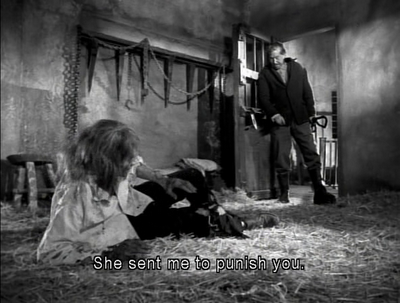
 You can see they light the hell out of everything and it all looks really great and spooky. They don't spare the horrors and rats and cobwebs and groping hands and sudden shocks. What's funny is that when they do the flashback explanation of the origin of the family curse they show it all in negative and a bunch of the scenes they use are a nonsensical jumble of shots from El mundo de los vampiros. I thought it was funny anyway. Oh yeah, the niece has a husband too but the great thing is he spends most of the movie in peril and really only gets useful when it comes to the climactic scenes when someone is needed to brawl with the club-footed scar-faced lackey. It's all about the ladies here and it's great. Rita Macedo as Aunt Selma is creepy as hell, always seeming weirdly elated over her evil power and not hesitating to do whatever she needs to do to achieve her wicked goals.
This concludes our week of holiday cheer and I wish you and yours all the joys of this wonderful Halloween season. Just be careful who wears the pants in the family, that's all.
Espiritismo (1962) is a domestic melodrama with a devilish twist. Mom and Dad are just celebrating their big anniversary and are extra happy because the mortgage on the house is finally paid off, and they feel they can ignore the dire warnings they got at that Ouija board party they went to the week before. Along comes junior who needs eight grand to start a crop dusting business and if they loved him they would mortgage the house again. Things don't seem to be working out after that and they are going to lose the house unless drastic actions are taken, so it seems like the natural thing to do is join a spiritualist cult and call upon the dark forces for aid. This takes the form of an emissary from the devil bringing Pandora's Box which, as you recall, contains a Crawling Hand that grants you your desires. Mom runs the show here, always puffing on a cig and ranting, and poor Dad can only tag along and watch the world fall apart. How it all turns out isn't too surprising. This is kind of slow and talky and is intended to appeal primarily to the housewife of those days, but it keeps a steady pace of mysterious events leading up to the inescapable conclusion that she shouldn'ta done that thing.


El maldicion de la Llorona (1963) a.k.a. Curse of the Crying Woman, is a real rip-snorter. You never know what is going to happen next. It's a multigenerational family curse story, the curse of an ancestor who made a deal with the devil to gain youth and power, with the catch being that to keep her youth and power she had to keep committing the most terrible crimes she could. This didn't go down well with the community. Most families don't keep the spear-transfixed skeleton of their most evil ancestor in the basement awaiting the day the youngest member of the clan turns 25 and pulls out the spear to bring her back to life, but this one does. And guess what. Home comes the young niece of the family who is exactly 24 and 364/365ths years old. All kinds of crazy stuff happens then. The aunt comes flying into the basement like a hideous skeleton and gets these empty eye sockets sometimes, and she's got no reflection and the niece loses her reflection the closer it gets to the fatal hour and the uncle they said was dead is actually a half human beast chained up in the bell tower but he GETS OUT when the club-footed scar-faced lackey goes up there to give him a GOOD BEATING, the dogs are let out to KILL POLICEMEN, and MIDNIGHT IS FAST APPROACHING. It's one nutty thing after another, and it all takes place in one night of terror.


This concludes our week of holiday cheer and I wish you and yours all the joys of this wonderful Halloween season. Just be careful who wears the pants in the family, that's all.
Tuesday, October 30, 2012
MEXICAN HALLOWEEN PART 6
Suffering sometimes brings rewards, and two nights of crap make a good night that much more pleasant.
El mundo de los vampiros (1961) was written by Alfredo Salazar, and directed by Alfonso Corona Blake who went on to bless the world with Santo Versus the Vampire Women and Santo in the Wax Museum. In the case of Sr. Blake I can assert that this movie right here was the greatest thing he ever did, probably. I have seen more vampire movies than I can count and I have never seen one quite like this. Filmed on the startlingly large and elaborate well-lit sets of Churubusco Azteca, it has a great look from the very first shot of a hand groping out of a slowly opening coffin. Multigenerational family curses seem to be a feature of Mexican horror stories, and this one is the three hundred year vengeance curse of Count Sergio Subotai, Vampire, against the descendants of the Colman family, and if he doesn't get his vengeance venged right now he will have to wait another hundred years. Another feature of these stories is hairy-handedness - when you get vampire bit the first sign of impending vampirism is you get hair on your hands. That is the universal sign of something going wrong in your life, when you get hair on your hands, because the next thing you know you are going to get claws and probably a big hairy pig nose and soon you will be running around in a cape and top hat going RAAAAAR! That doesn't happen in this though, I am just talking. You can forget about the plot and just watch the crazy things happening - the Bone Organ, the Pit of Impalement, the mob of stupid looking masked sub-vampires and spooky looking she-vamps, the fortuitous appearance of an expert on the psychological effects of music. And this:


El mundo de los vampiros (1961) was written by Alfredo Salazar, and directed by Alfonso Corona Blake who went on to bless the world with Santo Versus the Vampire Women and Santo in the Wax Museum. In the case of Sr. Blake I can assert that this movie right here was the greatest thing he ever did, probably. I have seen more vampire movies than I can count and I have never seen one quite like this. Filmed on the startlingly large and elaborate well-lit sets of Churubusco Azteca, it has a great look from the very first shot of a hand groping out of a slowly opening coffin. Multigenerational family curses seem to be a feature of Mexican horror stories, and this one is the three hundred year vengeance curse of Count Sergio Subotai, Vampire, against the descendants of the Colman family, and if he doesn't get his vengeance venged right now he will have to wait another hundred years. Another feature of these stories is hairy-handedness - when you get vampire bit the first sign of impending vampirism is you get hair on your hands. That is the universal sign of something going wrong in your life, when you get hair on your hands, because the next thing you know you are going to get claws and probably a big hairy pig nose and soon you will be running around in a cape and top hat going RAAAAAR! That doesn't happen in this though, I am just talking. You can forget about the plot and just watch the crazy things happening - the Bone Organ, the Pit of Impalement, the mob of stupid looking masked sub-vampires and spooky looking she-vamps, the fortuitous appearance of an expert on the psychological effects of music. And this:

I like to fell over when I saw this insanely wonderful human-headed bat. I have never seen that before ever. I have also never seen the main vampire suddenly in the middle of the big fight inexplicably grow big furry bat ears. To help him fight. Every minute of this movie is full of great stuff to see, even if it is just the imaginative way the big fancy set is lit - it's as gorgeously filmed as any great Hollywood b-movie of the 1940s. This is going on my list of all time favorite horror movies, second only to El espejo de la bruja (The Witch's Mirror). I have used up all my raving and will just fill this out with absolute proof of my assertions in the form of these images:


The lovely Erna Bauman, who went on to grace El vampiro sangriento
and La invasion de los vampiros with her solemn beauty.


Go and do likewise.
Monday, October 29, 2012
MEXICAN HALLOWEEN PART 5
Mexico - in the late '60s it was where old monsters went to die.
Fear Chamber (1969) was one of a batch of bargain basement movies Boris Karloff was lured south of the border to make for the sake of a paycheck - legend has it that paycheck was found uncashed among his effects after his death. I am sure the circumstances of the making of those films and their posthumous release has been well documented, if you care. I have seen one of the others, Snake People, and was surprised that this was not quite as dreadful as I had anticipated but still it is a disgrace in many ways. Karloff's character takes to a sick-bed part way through the movie and doesn't appear again until the very end to clean things up, but a good bit of his dialog throughout is delivered into a telephone while others carry on the action of the story - if you can call it a story. It seems he had discovered a type of subterreanean mineral intelligence by aiming some kind of atomic telescope at the earth's core, which fact is revealed near the end of the movie, in a dream sequence. That shows just how broken up and inept the plot, script and overall execution of this thing is. They don't seem to be able to shoot a scene in a way that you can tell what is happening, or in many cases so you can even tell what it is you are looking at. Perhaps they realized that the rock monster was so stupid looking they should not give it one clearly visible shot but instead shoot only blurry closeups of some lumpy thing twitching around with smoke and colored lights. Did I mention that to stay alive it needs a substance which is only formed in a human body in a state of terror? A female human body? That explains why they have to lure women into a spook house dungeon and torment them for a while before sucking out their blood for the monster rock. Luckily it grows an elephant trunk after a while which it can grab them with and suck their blood out, making the spook house and its associated henchmen unnecessary. I will give them one thing, the lab set looks pretty good.


See how hairy that hand is? It will soon be strangling. And see how crummy looking that set is? And see how lousy the print is? I had to tweak these images in a graphics program just to make them decipherable to you, which shows what a great guy I am. What you can't see here is the most horrible thing about the movie - the soundtrack. The opening credits are backed with a horrendous continuous random piano noodling and organ pounding and I thought, "My god, what am I going to have to endure?" The more exciting things were supposed to be the more random and horrific the background noise became. Worst of all were the laboratory scenes - even though there were no electronics of any kind the lab scenes were overlaid with a continuous wooping and bleeping noise meant to indicate apparatus I suppose. Four seconds worth. The same stupid and absolutely inappropriate noises repeating every four seconds the whole time anyone was in the laboratory.
I tell you, these two were pretty rough to make it through and I am going try to watch better things for the rest of this exercise because fun is fun but this ain't it.
Fear Chamber (1969) was one of a batch of bargain basement movies Boris Karloff was lured south of the border to make for the sake of a paycheck - legend has it that paycheck was found uncashed among his effects after his death. I am sure the circumstances of the making of those films and their posthumous release has been well documented, if you care. I have seen one of the others, Snake People, and was surprised that this was not quite as dreadful as I had anticipated but still it is a disgrace in many ways. Karloff's character takes to a sick-bed part way through the movie and doesn't appear again until the very end to clean things up, but a good bit of his dialog throughout is delivered into a telephone while others carry on the action of the story - if you can call it a story. It seems he had discovered a type of subterreanean mineral intelligence by aiming some kind of atomic telescope at the earth's core, which fact is revealed near the end of the movie, in a dream sequence. That shows just how broken up and inept the plot, script and overall execution of this thing is. They don't seem to be able to shoot a scene in a way that you can tell what is happening, or in many cases so you can even tell what it is you are looking at. Perhaps they realized that the rock monster was so stupid looking they should not give it one clearly visible shot but instead shoot only blurry closeups of some lumpy thing twitching around with smoke and colored lights. Did I mention that to stay alive it needs a substance which is only formed in a human body in a state of terror? A female human body? That explains why they have to lure women into a spook house dungeon and torment them for a while before sucking out their blood for the monster rock. Luckily it grows an elephant trunk after a while which it can grab them with and suck their blood out, making the spook house and its associated henchmen unnecessary. I will give them one thing, the lab set looks pretty good.


That blurry thing there is a representative shot of the monster. The print I acquired also included a scene of gratuitous nudity deleted from the general release, and believe me even a little gratuitous nudity can really pep up something this badly made.
Pacto diabolico (1969) is an unconvincing costume effort inspired by Dr. Jekyll and Mr. Hyde. There isn't all that much you can do with that story. You know eventually there is going to be a hairy-handed strangler involved, no matter what else happens. John Carradine plays a former colleague of Jekyll who hopes to alter the transformation technique to create an elixir of youth and it does transform him into a younger Mexican actor, relieving him of some responsibility for how this turns out. The essential ingredient of this elixir is just what you would expect - the eyes cut out of women's heads. Their eyes. Once again the magic of transformation baffles me, as Carradine's facial hair disappears with his wrinkles and reappears when the serum wears off. At least it doesn't transform his clothes. I watched him very carefully, and it appears Carradine delivered his lines in Spanish, but apparently it wasn't good enough so he was dubbed. Maybe there is an English print, I don't really care, but he does have one deranged line that I would enjoy hearing in his own lushly stentorian tones. This movie is meant as a period piece of a vaguely nineteenth century nature, and filmed mostly on cheap little sets that look just like cheap little sets and nothing more. They are brightly lit from above whether people are carrying a candelabra around or not. Fortunately there was a brief moment of gratuitous nudity, enough to give me hope that there might be another, which gave me the strength to endure the chasing and brawling that results when a hairy handed strangler goes after a young woman with a fiancee. For some reason the primary young woman in the movie is the daughter of Dr. Jekyll. That made me hope it might end up being a Daughter of Dr. Jekyll thing and that she might transform too, but no.


I tell you, these two were pretty rough to make it through and I am going try to watch better things for the rest of this exercise because fun is fun but this ain't it.
Sunday, October 28, 2012
MEXICAN HALLOWEEN PART 4
I figured I had better do some double features if I want to get all these things watched by Halloween so here we go with a Cowboys vs. Monsters double feature:
El charro de las Calaveras (1965) a.k.a. The Rider of the Skulls looks like it was meant as a pilot and two episodes of a kids' TV show, but judging by the online evidence of posters and lobby cards it was released as a movie. The Charro was orphaned when his parents were killed by bandits and he dedicated his life to Justice, remaining anonymous and masked because Justice is faceless. I'd like to point out though that recent history has shown that being masked or anonymous does not make you automatically Just. Sometimes it only makes you one of the monsters. Social commentary aside, in the first episode the Charro confronts a werewolf which has a transformation style I have never seen before - the guy falls in a faint and his fully clothed body fades into a naked skeleton, then back into a fully clothed werewolf. I have never understood the supernatural influence on attire and the way clothing tends to transform with the body. In defeating the lobo humano the Charro acquires a cowardly and foolish sidekick, and an orphan boy. In the second episode the Charro's costume undergoes significant changes, and the boy is replaced by a different boy but the cowardly foolish sidekick remains the same. They go on to encounter two more episodes, a vampire and a headless horseman, both of whom are among the lousiest looking monsters I have yet seen. I hate to stigmatize an entire people but in general Mexican movie monster makeup and masks are terrible.


 I don't know if it is just the fading of the Eastmancolor print or they couldn't afford to light the sets or what, but even the courtyard of the rancho is wrapped in gloom at the triumphant finale with Crazy Coyote yawning on his horse:

El charro de las Calaveras (1965) a.k.a. The Rider of the Skulls looks like it was meant as a pilot and two episodes of a kids' TV show, but judging by the online evidence of posters and lobby cards it was released as a movie. The Charro was orphaned when his parents were killed by bandits and he dedicated his life to Justice, remaining anonymous and masked because Justice is faceless. I'd like to point out though that recent history has shown that being masked or anonymous does not make you automatically Just. Sometimes it only makes you one of the monsters. Social commentary aside, in the first episode the Charro confronts a werewolf which has a transformation style I have never seen before - the guy falls in a faint and his fully clothed body fades into a naked skeleton, then back into a fully clothed werewolf. I have never understood the supernatural influence on attire and the way clothing tends to transform with the body. In defeating the lobo humano the Charro acquires a cowardly and foolish sidekick, and an orphan boy. In the second episode the Charro's costume undergoes significant changes, and the boy is replaced by a different boy but the cowardly foolish sidekick remains the same. They go on to encounter two more episodes, a vampire and a headless horseman, both of whom are among the lousiest looking monsters I have yet seen. I hate to stigmatize an entire people but in general Mexican movie monster makeup and masks are terrible.

Charro Mk. 1 meets the Old Witch in the abandoned cemetery:
Skull and crossbone logos on arms and back, cloth face mask.

Crummy looking vampire.

Charro Mk 2 - logos on chest and plain skull on back, full head mask

Idiotic looking headless horseman head in box.
The monsters are intentionally not very scary because this is standard kids' show stuff - chase around, fight the monster, happy ending. What interested me was the rural settings and decaying brick farm architecture of the locations where all the chasing and brawling was filmed. Scholars of the Cinema should note that it was directed by El maestro de los Monstruos, Alfredo Salazar, who as writer created the most outrageous monsters of the Mexican cinema. Name a famous Mexican monster or masked wrestler movie and chances are, Salazar wrote it. As director, maybe not so good.
El grito de la muerte (1959) was renamed The Living Coffin for its U.S. release, but there are more screams of death than there are living coffins in it. There are strange doings on the old rancho, with a murderous Crying Ghost weeping over the deaths of her children in the quicksand swamp and clawing up the faces of her victims, and it has something to do with a fortune in gold. Luckily along comes Gaston Santos, Cowboy Detective, and his stupid lazy sidekick Crazy Coyote - the same sidekick known as Squirrel Eyes in Swamp of the Lost Monsters, but wearing a coonskin cap this time. The dancing horse doesn't do any dancing in this one but it does pull Gaston out of the quicksand and show him where the secret panel is that the ghost comes out of. Swamp of the Lost Monsters was mostly filmed in rural locations, but except when Gaston is riding around the countryside or falling in the quicksand this is filmed in the gloomy arched sets of Churubusco Azteca. In fact the street scene set looks like a rusticated and expanded version of the one in The Monstrous Doctor Crime:


When Gaston Santos takes a hand in things you know there aren't really any monsters, just criminals in monster suits, and everything will turn out okay after a lot of chasing around and brawling. So, nothing really exciting here but I got these out of the way at least.
Saturday, October 27, 2012
MEXICAN HALLOWEEN PART 3
I have mostly recovered from my physical suffering, leaving me only my usual mental suffering to cope with, so it is appropriate that I should enjoy a movie about lunatics on a rampage.
THE MANSION OF MADNESS (1973) is an hallucinogenic-expressionist rendition of Poe's story The System of Dr. Tarr and Professor Fether, which explores the simple premise of lunatics taking over the asylum. Though made in Mexico it more closely resembles many European gothics which begin with a coach rumbling through misty woods toward an eerie castle. In this case the castle is acknowledged from the beginning to be a lunatic asylum, instead of you having to figure out along the way that everybody is nuts. There is not much to Poe's story besides the situation. His writings never seemed fully comprehensible to me, being more mood than meaning and more poetry than plot, and this film does a good job of carrying that through. At that point in history when this was made, the civilized world had been on drugs for years, wallowing in sexual and social libertinism, and it was just at that time that many filmmakers got the idea they could do any damn thing they wanted. Movies like The Holy Mountain, Sweet Movie, and O Lucky Man! not only got made but watched, and there was a market for exercises in excess. This particular mansion of madness was created in some remarkable scenes of industrial decay and creates an effective mood of derangement suitable to its origin in Poe's brief but intense story of lunacy liberated.


Addendum: Scholars of the Cinema will find it worth noting that the director, J.L. Moctezuma, was producer of Jodorowsky's Fando and Lis and El Topo.
Thanks also to reader Lou Minatto for noticing that Artistic Supervision was credited to noted Surrealist painter Leonora Carrington. That explains a lot about how this movie looks.
THE MANSION OF MADNESS (1973) is an hallucinogenic-expressionist rendition of Poe's story The System of Dr. Tarr and Professor Fether, which explores the simple premise of lunatics taking over the asylum. Though made in Mexico it more closely resembles many European gothics which begin with a coach rumbling through misty woods toward an eerie castle. In this case the castle is acknowledged from the beginning to be a lunatic asylum, instead of you having to figure out along the way that everybody is nuts. There is not much to Poe's story besides the situation. His writings never seemed fully comprehensible to me, being more mood than meaning and more poetry than plot, and this film does a good job of carrying that through. At that point in history when this was made, the civilized world had been on drugs for years, wallowing in sexual and social libertinism, and it was just at that time that many filmmakers got the idea they could do any damn thing they wanted. Movies like The Holy Mountain, Sweet Movie, and O Lucky Man! not only got made but watched, and there was a market for exercises in excess. This particular mansion of madness was created in some remarkable scenes of industrial decay and creates an effective mood of derangement suitable to its origin in Poe's brief but intense story of lunacy liberated.


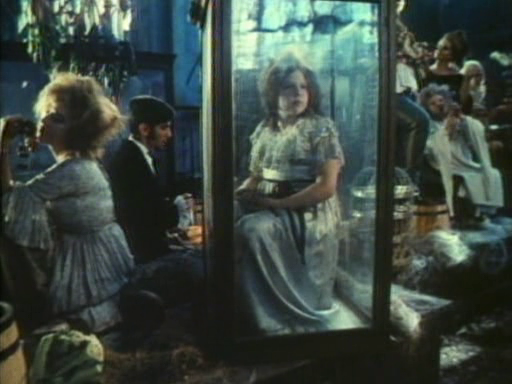
Even if you don't have any drugs to take this is still a freaked out headtrip, but it maintains an attitude of culture and sophistication throughout, never seeming to indulge for the sake of mere shock value. The film appears to have High Art intentions and was made early enough in that period of accelerating decadence that it can be judged as a success in that regard.
Addendum: Scholars of the Cinema will find it worth noting that the director, J.L. Moctezuma, was producer of Jodorowsky's Fando and Lis and El Topo.
Thanks also to reader Lou Minatto for noticing that Artistic Supervision was credited to noted Surrealist painter Leonora Carrington. That explains a lot about how this movie looks.
Subscribe to:
Posts (Atom)