Showing posts with label comedy. Show all posts

Monday, December 24, 2012

Lady Detective Holiday - ADVENTURES OF KITTY O'DAY

Adventures of Kitty O'Day (1944) stars the mildly attractive, yet strangely forgettable, Jean Parker as the hotel switchboard operator who reads detective magazines and listens in on people's calls, so she naturally overhears a murder.  She is not so much a detective as a nosy meddler, and this is not so much a mystery as it is a farce of the vanishing corpse variety.  The story is so unimportant to the film that it is left to a brief unintelligible explanatory monologue at the end, but nobody in it or watching it gives a damn who did what to who and why.  Directed by world champion hack William Beaudine, this is a formulaic stand-in for a detective story, just as the characters are formulaic stand-ins for real people.  They are types - the nosy meddler, her frustrated boyfriend, the vamp, the overdressed older woman, the angry police detective and his absurd sidekick.  The types are played by actors who fit the role and who can get the job done as quickly as possible.  I knew when I saw Parker that I had seen her before a bunch of times but couldn't remember where or when.  I am still having trouble remembering her name.  Here she is with ever-present Byron Foulger, doing his bit as desk clerk.
Parker had a career of over 30 years with numerous starring roles, almost entirely in B movies.  She was in a few notable films, such as Little Women (1933) and Laurel and Hardy's Flying Deuces (1939), but mostly appeared in anything that needed someone to be The Girl opposite a handsome action man; adequately entertaining minor productions like No Hands on the Clock (1941) and Wrecking Crew (1942) with Chester Morris and Alaska Highway (1943) with Richard Arlen.

The only contact this movie has with the outside world is a couple of references to the "manpower shortage," which pops up a lot in movies from this period of the war.  Even its brief "outdoor" scenes consist of one tiny set with two park benches and some shrubbery. A cultural note of minor interest is one of the few film appearances of  Shelton Brooks, seen here as Jeff the Custodian along with what's his name who did something or other in the movie.  Brooks was an old time minstrel and vaudevillean, who composed the standard Dark Town Strutters' Ball, and Sophie Tucker's signature tune Some of These Days.
I think I have made it pretty clear that there is not much to this - the second half devolves into a lot of chasing around and everyone eventually goes down the laundry chute, but in the part that relies on dialogue between a few people standing in an unnatural arc roughly facing the camera, it has some laughs.  It is mostly inoffensive, and that is sometimes enough.

Saturday, May 26, 2012

EUROVISION BRIEFLY EXPLAINED

Every year around this time I baffle my acquaintances with my repeated references to the Eurovision Song Contest.  I will attempt to clarify my interest in this, to Americans, otherwise entirely nonexistent event.  I watched a documentary on it last year, but I am not looking anything up and am just doing this off the cuff.  The cuff on the top of my head so to speak.

The Eurovision Song Contest Grand Final is the single most-watched television broadcast throughout Europe and has been for umpteen years, since the earliest years of television.  It was so popular that East Germany had to create its own Soviet version to keep the comrades from mentally defecting.  It is a confluence of many disparate streams of sociopolitical, cultural and diplomatic influence.  It has had a genuine permanent impact on international relations between European nations on more than one occasion. The nation which wins is the host of the next year's event and that adds complications. Here are some of the things going on with this thing:

  1. Grand Spectacle of Schlock  Eurovision is a multinational Lawrence Welk show and the intent is to create music which appeals to the greatest number of people.  Occasionally, as with Germany's winning song Satellite, by Lena Meyer-Landrut, it results in a conjunction of appealing song and singer which can be captivating.  Most often the result is a mopey pop ballad, a jingoistic anthem, or some kind of ethno-folk disco atrocity.  When we try to appeal to the greatest number of people we may end up appealing to none.
  2. National Advertisement A relatively obscure country like this year's host Azerbaijan can find in Eurovision a mini-olympics, a nearly affordable platform to show itself a capable nation.  The fact that it can put across a big expensive event like this demonstrates that it may be a functional business partner in an unusual corner of the world and provide valuable goods and services to multinational corporations.  If the host is a deranged autocracy like Azerbaijan it is an opportunity to show that it is not a deranged autocracy, and the way to do that is to become even more of a deranged autocracy, bulldozing homes to build a venue for the event, and suppressing even more harshly than usual the inevitable public rebellion which results.  This shines a light upon the actions of the regime in the international press.  Even non-winners can gain some publicity from losing, like the autocrat of Belarus who last year revealed the paranoid mindset of the dictator by blaming collusion for the failure of the the Belarussian entry, titled I Love Belarus, to take the laurels.
  3. Melting Pot Hundreds of people from dozens of countries, not diplomats or politicians but for the most part fairly normal people, meet in one place to rub elbows, sing songs, and try to create some happiness in the world.  Millions of people in all those countries are watching the same show at the same time, seeing that people in other lands are just people like them who enjoy having fun or shedding a maudlin tear over a song.  That can never ever hurt anyone.
  4. In It To Lose It One of the most fascinating aspects of it is the winner's obligation to host the next year's event.  All the participating nations want to be seen as competitors but not all of them want to win.  Countries like Spain and Greece which are in bad financial straits, or little countries like Andorra and Montenegro, can't afford a 200 million dollar throw-away like Eurovision.  When Ireland won it three years in a row it was a bit of a disaster.  We end up with performers who want to be good, but not too good, songs that were written to lose but not to lose badly.  It's great to make it to the finals but for god's sake please don't win.
That, extemporaneously, is what Eurovision means to me.  I'm going to try streaming it live to see the opening, and then will download it when it pops up in the torrent trackers later on, because I have never been able to enjoy, or endure, the thing in its entirety.

Now you know what I know about the Eurovision Song Contest.

Sunday, September 18, 2011

Movies

Naked Alibi (1954) is a weirdly unconvincing noir starring Sterling Hayden, Gloria Grahame and Gene Barry. Barry overacts horrifically as a volatile bakery owner, Hayden is the disgraced ex-police chief trying to prove Barry is a cop-killer, and Grahame is the woman in between.  Hayden and Grahame are good actors, and both kind of unusual looking, so they go together well, but this takes place in the world where there are towns called things like Border City, with streets that all curve so you can only see two blocks and not into the Medieval Paris or New York part of the backlot a few hundred yards away. The strange unbelievability of the production is distilled in Grahame's execution of the following peculiarly trashy dubbed musical number in an overlit soundstage Border City cantina with music but no band. Still there is something irresistibly seductive to me about her unusually tiny mouth - I find it hard to look at anything else when she is onscreen. 6/10 overall, but for weirdness it is more of an 8.


The Time of His Life (1955) Offbeat independent British comedy in which a snobbish matron must endure the reappearance of her convict father, whose only desire is to go back to jail where he belongs.  It relies mostly on prolonged slapstick and pratfalls for its "laughs" and could have been more amusing if it had simply gone with the appeal of the characters and circumstances. The only face I recognized was bespectacled Richard Wattis. Kind of a chore to sit through, but the organ and vibes soundtrack added a sort of Mr. Hulot emotional appeal and there is a song. 4/10

Friday, September 2, 2011

Movies


Genius at Work (1946) stars obscure comedy duo Wally Brown and Alan Carney, and it is a real puzzle how these guys got over half a dozen starring vehicles.  They have no schtick, no outstanding features of any kind except that one of them is not jewish.  Here they are - now you will remember them forever.


This is alleged to be a re-make of the Wheeler and Woolsey movie The Nitwits - I will watch it to find out, and I won't mind because Wheeler and Woolsey can actually be funny sometimes.  Most people don't even know who W&W are nowadays and here are Wally Brown (R) and Alan Carney (L) eating off of their table. Not even enough of a team to be called Brown and Carney.  They are supposed to be a couple of radio announcers who do a crime program and fall afoul of a Master Fiend called The Cobra who baffles the police with his nefariousness.  Studio villain Lionel Atwill is hauled in for that role and Lugosi is reduced to henchman status.  The only really notable thing in the movie is pictured below - Lugosi in spectacles and phony beard, Atwill in granny drag, in a wheelchair, using a poison needle blowgun to commit his shocking murders.  The less said about that the better.  This is a flat factory-made bill-filler cranked out to fill time, not seats, and of no conceivable interest to anyone, not even me.


Wednesday, August 31, 2011

Movies - Frances Langford again

 I had bookmarked Girl Rush (1944) a while ago because it stars the obscure comedy duo of  Wally Brown and Alan Carney, but when I realized it also features Frances Langford I decided I'd better download it and get it watched.  Well, it's pretty terrible, combining a mediocre Gay Nineties music hall story with a flat RKO western and the Brown-Carney duo seems to me to be justly forgotten.

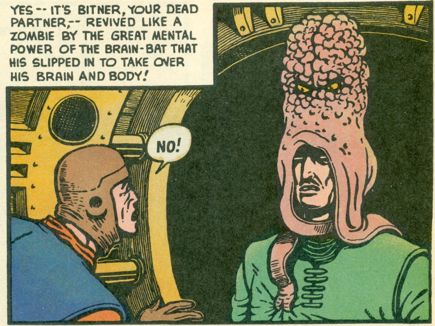
 Langford's hair is again an enormous superstructure some five or six inches high, perched atop her head like a Venusian Brain Bat but with sausage curls added in the back for that Gay Nineties look. To be fair, most of the girls in the movie have the same sort of hairstyle but hers is far and away the most huge and imposing. The movie is mercifully short, and other than feeding my temporary Langfordmania its only really notable moment is during the scene we see below - Robert Mitchum in drag.


As I was sitting in the sauna at the health club today, pondering the mystery of Frances Langford's immense hairdo, I recalled this scene from Dixie Jamboree, where she takes the wheel of the riverboat in a cartoonishly enormous captain's hat.  It was then that I figured it all out.
  In the 1920s and 1930s, it was cute to be little.  There was nothing more charming than a chest-high jazz-baby gazing up at her big strong man and a sweet little gold-digger like Joan Blondell could wrap any man around her little finger just by acting helpless.  In the '40s small women were not hep.  It wasn't cute any more to be little except in a juvenile role or as comedy relief, probably because the war effort demanded more of women and they were, temporarily at least, taking on a more autonomous and self-determining role in society.  Frances Langford was five feet one inch tall. Like the even more diminutive Carmen Miranda she was tricked out in high heels and big hats, and her colossal coiffure, to make her more acceptably large.  It really is a terribly unflattering style for her, and I find her much more human looking (and her vocal style more interesting) in this clip from the 1930s.

Monday, January 10, 2011

Movies

Mummy's Boys (1936) Comedy duo Wheeler and Woolsey are a pair of ditch diggers who join an archaeological expedition plagued by a mummy's curse. A lot of chasing around, not as much vaudeville-style presentation as some of their other films and thus not as interesting to me. 3/10

Inception (2010) Good concept, well executed, but a bit heavy on the noise and stuff crashing into other stuff and things blowing up for my tastes. In short, too big and expensive. I'd like to see the same idea pared down to its basics and presented as simply as an old Outer Limits episode. 6/10

Wednesday, December 29, 2010

Movies

It's a good thing I make notes on my desk blotter or I would forget all this holiday indulgence:

Son of Ali Baba (1952) Tony Curtis is browned up for a glamor-boy turn in this cheesy costume potboiler. They couldn't drive an extra half hour to shoot the horse chase scenes in the desert, so this Bagdad is nestled amid rolling hills clad in sagebrush and scrub pine. Colorful filler, more fun than a bible movie. 3/10

Les Belles (1961) "Qian jiao bai mei" is the vernacular title of this Hong Kong romantic musical comedy from Shaw studios, focusing on the lives and loves of members of a modern dance troupe. It is notable mainly for the fact that it is presented in a very western style, with little distinctively Chinese culture intruding beyond a couple of historically themed dance numbers. I have become accustomed to the Hollywood treatment of the latin theme but it is jarring to see a latin dance number done with Chinese tonalities. It's clear they had little experience in staging western style dance numbers, which strive for exoticism but are rather flat and dull. Very brightly illuminated and colorful, with some peppy songs and bizarre dance settings, but rather long at two hours. Of interest mostly as an oddity and for cultural comparison. 5/10

Spiderweb number - in ShawScope. It's wide.

Sunset Murder Case (1938) Burlesque dancer Sally Rand stars in this poverty row B pic, and her bubble dance was the reason I watched it. It's pretty mild until the last moment, when she briefly, and heavily backlit, drops her filmy wrap to show her form. A fan dance number was apparently too revealing, so it's concealed behind palm frond silhouettes inserted over the frame, making me wonder if there might have been a "special" version of the film which lacked them. Otherwise it's another brief gunshots and gangsters story. 4/10

The famous Bubble Dance

Yes Sir, Mister Bones (1951) Hour-long cheapie about a retirement home where old Minstrels lurk, waiting for someone to come along and ask them what a "minstrel show" was. Does a fair job of conveying the spirit of the artform, if not the letter - the music is pretty swingified - with a couple of remarkable turns from Scatman Cruthers, some nostalgic Negro Spirituals, and some grating blackface "comedy." The black performers are uniformly superior, the blackfaces pretty hard to take. It does show the omnibus nature of the minstrel show, providing all varieties of entertainment in one grand spectacle, but a more realistic flavor can be gotten from 1952's Stephen Foster faux biopic I Dream of Jeanie, or Shirley Temple's 1936 film Dimples. Directed by Ron Ormond, and it's not the weirdest thing he did, not by a long shot. 5/10

Side note - Ron Ormond is perhaps least known for this contribution to popular culture - the line "christianity is stupid," from his christian commie-scare film If Footmen Tire You, What Will Horses Do, which was put to use by Negativland.

The Hayseeds (1933) An Australian romantic musical comedy, as it proudly proclaims on the title card, and it makes quite a thing out of being Australian too, with monologizing on the Australian national character, and random insertion of wildlife footage. The romantic duet spends as much time showing the Sydney harbor bridge as the young lovers. This is the first film appearance of South African born Cecil Kellaway, who later found quite a bit of work in Hollywood. The quaint, countrified Hayseeds spend some time chasing trollleys in the bustling streets of Sydney, which looks as vast and towering as Chicago. The plot and songs are adequate, and this is an interesting novelty that doesn't tire you overmuch. 5/10

Forbidden (1953) An adequate exotic noir, placing Tony Curtis in a backlot Macau intrigue. Joanne Dru is the adequately angular and immaculate woman with a history. The story is convoluted without being indecipherable, the dialog is full of mild congenial phrases forced through gritted teeth, and it comes to an adequately active climax. The primary song in this universe is You Belong to Me (See the pyramids along the Nile etc.) and I suppose this is the film that made it popular - it's still rotating through my head today. It all looks good and stays interesting, but there is a wee bit too much standing around talking, and jumping into cars and dashing off somewhere for me to say it was great. Pretty good though. 7/10

I also watched quite a bit of Toomorrow (1970) - it seems the masterminds behind The Monkees wanted to do it again, this time with a movie in England. Extraterrestrial observers find that a pop band featuring Olivia Newton John is the only source for the healing vibrations they crave. Aimed at an older audience, with art-school protests and sit-ins a major plot element, it is peculiar without being interesting.

Japanese release. Also very wide.

Thursday, December 23, 2010

Movies

El verdugo (The Executioner) 1963 - Spanish comedy in which a newlywed must take over his father-in-law's job as executioner to save their apartment. The means of execution in Spain at the time was the garrote. Might have been more entertaining if it had not been so verbose, and if the amateur subtitler had not been determined to capture every bit of crosschat and radio background, sometimes filling the screen with indecipherable text. Interesting to see the locales and culture, but wearisome. 2/10

Then I made it through half of Who Was That Lady? (1960) starring Tony Curtis, Janet Leigh and Dean Martin. Leigh and Curtis' chemistry is unmistakable, but Dean is the only one truly in his element in this feeble sitcom. Curtis, supposedly a chemistry professor, is caught kissing a student in his lab and turns to his chum Dean, a TV writer, to save his marriage. Which means pretending he is an FBI agent, with ensuing "hilarity." I'd hate to be stuck on a desert island with this thing. 1/10

Sunday, December 5, 2010

Movies

Search for Beauty (1934) Robert Armstrong, James Gleason and Gertrude Michael are two bit hustlers trying to make it big in the Health Racket; Buster Crabbe and Ida Lupino are the Olympic athletes they hire as a front, who queer the pitch by forcing them to play it straight. Lupino is here a bleached blonde with pencilled eyebrows and a bit of a British accent and it took me half an hour to figure out which one was her. Strangely, the movie does the same thing the hustlers want to do - sell cheesecake and beefcake under the guise of health and exercise. Lots of healthy young people in bathing suits leaping and stretching. I've never seen anything quite like it. Odd but not great. 5/10

Xica da Silva (1976) Brazilian costume fantasy very loosely inspired by the true story of the title character's rise from slavery to the pinnacle of wealth and power in colonial Brazil, as mistress of the controller of the nation's diamond mines. An extremely colorful story in every way, with fascinating costume, architecture, landscape and characters. Xica is vibrantly portrayed by the charismatic Zeze' Motta, who seems to have had an extensive career in Brazilian film and television. Maybe not strictly educational, as it varies widely from historic fact, but quite entertaining. 8/10

Zeze' Motta as slave...

...and as queen.

Saturday, December 4, 2010

Movies

Let Us Be Gay (1930) Norma Shearer is nearly unrecognizable as a dowdy housewife humiliated by her husband's infidelity. Three years after their divorce she is an Independent Modern Woman and they encounter each other again. Hence the gaiety of the title - heavily forced to show she "doesn't care" and it got so every time she giggled I just wanted to slap her. This is my least favorite Norma Shearer movie so far and I just want to see one where she doesn't get divorced at the beginning and then get back with her husband again in the final shot of the film. 4/10

Before divorce.

After.


RRRrrr!!! (2004) French caveman comedy. Has its moments, with more laughs than the Ringo one. It's a comedy, about cavemen. I like how all the animals have tusks, even the ducklings. Donna slept through part of it, and rightly so. 5/10

Friday, November 26, 2010

Movies

I completely forgot that I also watched La gran aventura de Mortadelo y Filemon (2003) yesterday - a Spanish spy farce in which two goofy "super-agents" must recover a stolen secret weapon from a nearby dictator. It's as deliberately cartoonish and absurd as possible, with people being hit by speeding cars and leaving a pair of smoking shoes behind, or smashed down by a blow on the head and waddling off one foot high. A less developed audience might find this one continuous howl from start to finish, and hurt themselves screaming with laughter, but I found myself admiring the effects yet never laughing once through the whole movie. Then it passed from my mind like a dissipating mist. I have to write this quickly before I forget about it again. ?/10

Wednesday, November 3, 2010

Movies

Hiroku Kaibyoden [The Haunted Castle] (1969) Another version of the story filmed in 1958 as Mansion of the Ghost Cat. This version is from a classier studio and is a straight-ahead costume spook story of samurai days. The beloved pet of an unjustly slain vassal becomes a vengeful demon to punish the murderous lord of the castle. While it builds quite a bit of tension by keeping almost all of the action in claustrophobic night-dark hallways, with characters floating in isolated spheres of dim light, it really doesn't compare to the earlier version for imagination and sensation. Has its moments but you definitely want to go with the earlier one. 5/10

Echappement Libre [Backfire] (1964) Belmondo, Jean Seberg, and a Triumph Spitfire convertible made of gold wandering around the mediterranean. Sort of a heist movie so you can figure how it's going to end up. Never really makes a whole lot of sense, builds chemistry between the characters, or becomes very interesting. Passes the time painlessly, and is not challenging. 5/10

Wednesday, September 1, 2010

Movies

The Elegant Life of Mr. Everyman (1963) Sharply satirical Japanese version of the '60s office comedy. The protagonist can't find anyone to go drinking with him after work because he becomes ranting and argumentative, but those are the qualities which attract the attention of the editors of a popular magazine, who compel him to write a column for them. His wandering tales of his inept life and pathetic family become a surprise hit and win a literary award. Finally in a position where people will listen to him, he becomes a tediously babbling jackass boring the hell out of everyone with his inane blather. Innovative technique and presentation help brighten up the story, and it is quite amusing at times. 7/10

Queen Bee (1955) I got this Joan Crawford film to watch with Donna, but misfired again as it seems she likes Crawford films that require her to act, rather than simply be herself, as she does here. It's an over-the-top Southern Gothic melodrama with a neutral innocent arriving at a moss-draped manse (sans southern accents) to plunge into a maelstrom of raging passions. I thought this was the perfect Joan Crawford film - she is so sweet and kind you just can't understand why everyone obviously hates her so, until the claws come out and she goes around the room ripping the guts out of everyone, one by one. Blunt and deranged story which provides everything required and more. Crawford starts the film draped in soft furs, all sweet and bright, and ends it wrapped in shining satin and stiff, glittering metallic gowns like a fierce deadly black-eyebrowed machine. She is utterly inhuman throughout. Donna didn't care much for it but to me it was just right. 10/10

The Astounding She-Monster, poised for the kill.

Uncle Joe (1941) Mild Poverty Row comedy in which pert young Gale Storm is sent by her soap-magnate father to live in the country with eccentric inventor Uncle Joe, to keep her away from her beau, a painter of Metaphysical Abstractions. She pretends to play accordion with the local hillbilly jazz combo, and they all conspire to help the local widow (Zasu Pitts) save her home by winning the limerick contest sponsored by pater's soap company radio show, which provides the excuse for simply dropping in a few unrelated songs by unfamiliar performers. Overall quite watchable and amusing. 7/10